
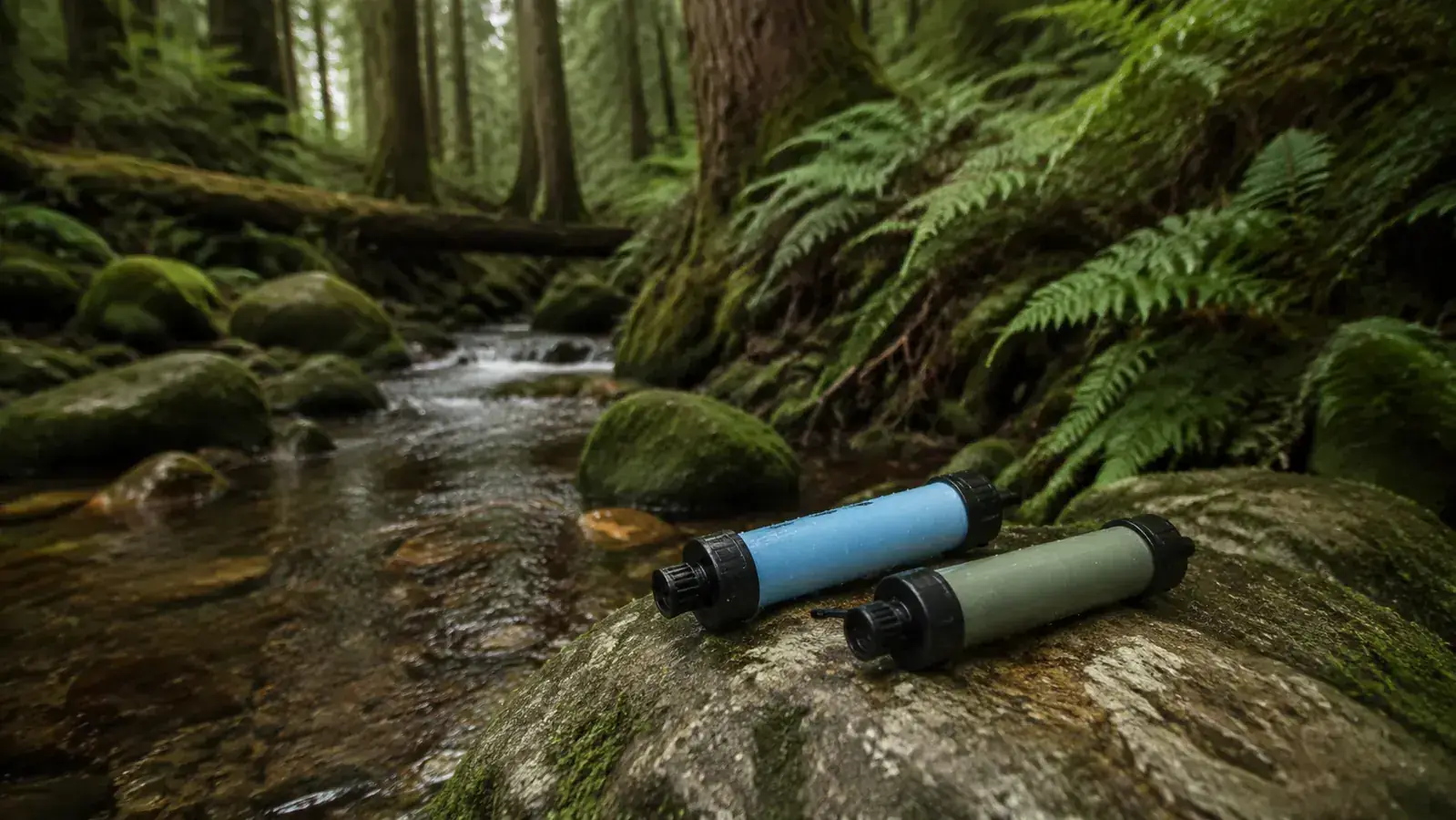
I want to answer this straight: I pack the Sawyer Squeeze every time. Have been for three years running. But I did not arrive at that answer on the first trip. I bought a LifeStraw first, back when I was new enough to backcountry travel that I just grabbed whatever had the most Amazon reviews and the coolest marketing video. The LifeStraw is popular. The LifeStraw is inexpensive. And the LifeStraw has one design flaw that most comparison articles quietly sidestep. I am not going to sidestep it.
This comparison covers both filters head-to-head based on real use in wet, muddy, cold Pacific Northwest conditions. I will tell you where the LifeStraw genuinely holds up, where it falls short, and why the Sawyer Squeeze is the filter I trust when the source water looks like last week's parking lot runoff from a logging road in the Olympics.
| Spec | Sawyer Squeeze | LifeStraw Personal |
|---|---|---|
| Weight | 3.0 oz (with one pouch) | 2.0 oz |
| Filter life (liters) | 100,000 (unlimited with backflush) | ~1,000 |
| Flow method | Squeeze pouch, gravity, inline, drink directly | Straw only (drink directly from source) |
| Filtration rating | 0.1 micron absolute | 0.2 micron absolute |
| Filters viruses? | No (same as LifeStraw standard) | No |
| BPA free? | Yes | Yes |
| Can fill a container? | Yes | No |
| Backflushable? | Yes, with included syringe | Yes, blow back through |
| Current price (approx.) | ~$46 | ~$20 |
The Core Problem with the LifeStraw
The LifeStraw is a straw. That sounds obvious, but it is worth sitting with what that actually means in the field. You get down on your hands and knees at the water source, put the tube in, and drink. That is the only mode. You cannot fill your cook pot. You cannot fill your friend's bottle. You cannot set up a gravity filter system and let it drip into your hydration reservoir while you make dinner. Every sip of water for the day requires you to be physically at the water source, crouched over it.
On a three-day loop in the North Cascades last September, my hiking partner brought a LifeStraw. By day two, he had identified the exact problem: you cannot pre-hydrate. You cannot fill a 32-oz bottle for the dry ridge section between creek crossings. Every time he was thirsty on the trail, he needed to wait until the next water source and spend two minutes drinking in place. Meanwhile I had filled a 32-oz pouch at the last creek, squeezed it into my Nalgene, and had water in my hand for the next two miles. That flexibility is not a minor convenience difference. In a long dry stretch on a hot day, or in a situation where you cannot safely stop at a water source, it matters.
Where the Sawyer Squeeze Wins
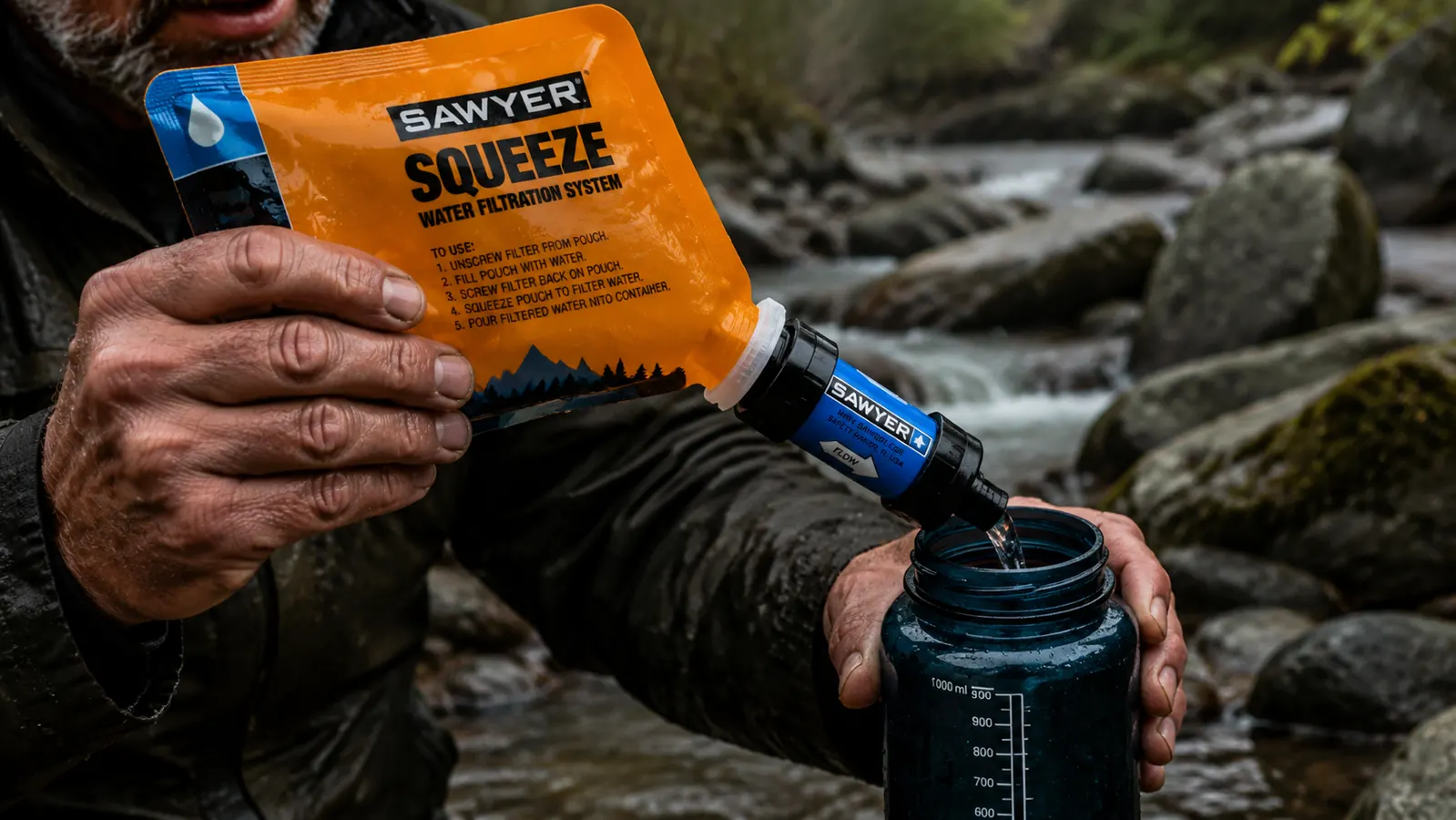
The Sawyer Squeeze SP131 comes with two 32-oz squeezable pouches and a small backflush syringe. You fill a pouch at the source, thread the filter onto the pouch, and squeeze water through into your drinking vessel. Alternatively, you can drink directly through the filter, use it inline with a hydration hose, or hang it as a gravity filter. A single filter will last essentially forever with proper backflushing; Sawyer rates it at 100,000 gallons, which means you will never buy a replacement filter if you maintain it correctly.
The 0.1-micron membrane removes Giardia, Cryptosporidium, bacteria, and protozoa. It does not remove viruses (neither does the standard LifeStraw, so this is a wash for domestic backcountry travel where viral contamination in surface water is extremely rare). Flow rate is solid. A full squeeze of the 32-oz pouch takes me about 60 to 70 seconds at typical hand pressure. After backflushing, it is even faster. The filter housing is a firm, smooth plastic. It has held up to three winters of use without cracking, though the squeeze pouches are the weak link over time. I am on my third set of pouches now. The filters themselves have never needed replacing.
By day two, my partner had identified the problem: with the LifeStraw, you cannot pre-hydrate. Every sip requires you to be physically at the water source.
For PNW backpacking specifically, I sometimes use the Sawyer Squeeze as part of a gravity setup on multi-night trips. I thread the filter onto one of the pouches, fill the pouch at the creek, hang it from a branch with a bit of paracord, and run the output directly into my cook pot. It is slow compared to squeezing actively, but it means I can filter dinner water hands-free while I set up camp. The LifeStraw cannot do any version of this.
Your water source doesn't care about your filter's marketing budget. Get a filter that fills a bottle.
The Sawyer Squeeze has 10,000+ reviews, a 4.7-star rating, and costs around $46 with two pouches and a backflush syringe included. Check today's price on Amazon.
Amazon Check Today's Price on Amazon →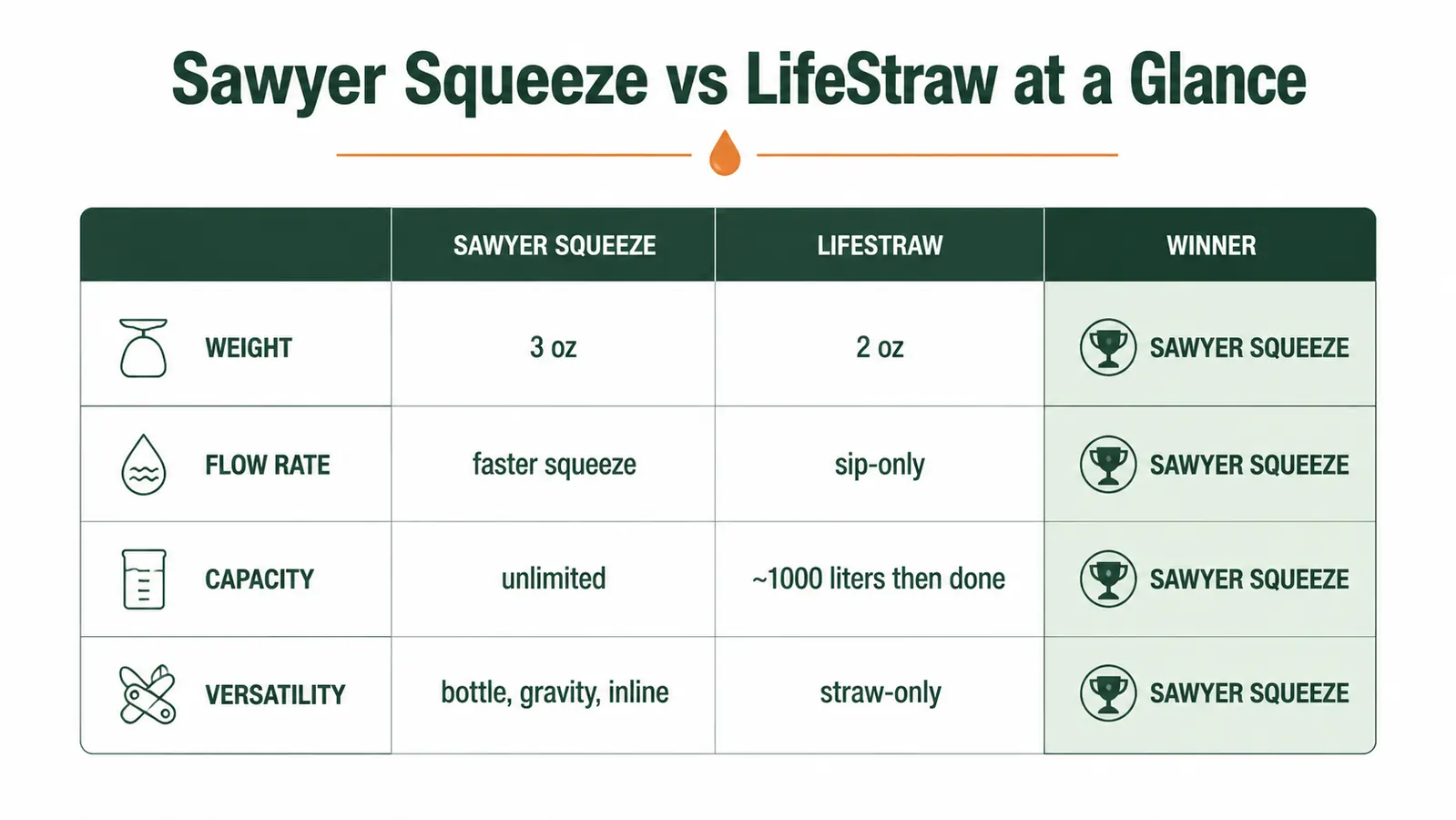
Where the LifeStraw Wins
The LifeStraw does two things better than the Sawyer Squeeze, and I want to be honest about both of them. First, it is lighter. A LifeStraw Personal weighs 2 oz flat. The Sawyer Squeeze with one 32-oz pouch weighs 3 oz, and realistically you want two pouches, which adds another ounce or so. For someone optimizing a gram-counted ultralight kit, that gap is real. Second, the LifeStraw is slightly cheaper at around $20. If you are building a minimalist day-hike emergency kit or you want a filter to keep in your car's emergency bag rather than for serious backpacking, the LifeStraw is a reasonable choice. It is compact, reliable for what it does, and costs less.
The LifeStraw also requires no accessories to work. There is no pouch to fill, no syringe to keep track of, no threads to cross when reassembling after a cold morning with numb fingers. You pull it out and drink. For fringe emergency scenarios where the goal is survival over convenience, that simplicity has some appeal. I keep one in my car's get-home bag alongside a mylar blanket and a fire kit. For that purpose, the LifeStraw makes sense.
The Filter Life Question Everyone Ignores
LifeStraw rates its personal filter at 1,000 liters before it needs replacement. That sounds like plenty until you think about it in trip terms. A liter of water per hour is a conservative estimate for moderate hiking. On a five-day trip with two people, you might filter 20 to 30 liters. So you could get 30 to 50 five-day trips out of a LifeStraw if you tracked it carefully and replaced it on schedule. In practice, nobody tracks this, and the filter can become blocked before you reach the rated capacity if you are filtering silty or high-sediment water, which is common in glacial melt sources and after Cascades storms.
The Sawyer Squeeze, by contrast, is rated at 100,000 gallons. With proper backflushing after each trip, it does not degrade in rated capacity over time. My three-year-old filter still moves water at the same rate as it did new. The replacement cost equation also favors the Sawyer: one filter for the life of your hiking career versus periodically buying new LifeStraws or replacement filters. The higher up-front price of the Sawyer Squeeze pays itself back quickly.

Cold-Weather Performance and What Kills Both Filters
There is one area where both of these filters are completely equal, and you need to know about it before you buy either: freeze damage. A wet hollow-fiber membrane that freezes will crack internally. The damage is invisible. The filter will still move water, but it will no longer reliably remove bacteria or protozoa. This is not a LifeStraw or Sawyer problem specifically. It is a membrane filter problem across the board. Both companies say the same thing in their documentation: do not let your filter freeze while wet.
In practice, on shoulder-season Cascades trips where overnight temps drop below 30 degrees, I sleep with my Sawyer Squeeze in my sleeping bag. It takes about 30 seconds to tuck it near my legs before I zip up. I also backflush and shake out as much water as possible from the membrane at the end of each day. If you filter water and then leave your filter outside in below-freezing temps overnight, both the Sawyer and the LifeStraw will potentially be compromised in the morning. Neither filter comes with any indicator that freeze damage has occurred. You have to manage the cold exposure yourself.
Who Should Buy Which
Buy the Sawyer Squeeze if you are going on multi-day backpacking trips, car-camp trips where you want to filter your own water, or building a serious go-bag for emergency preparedness. The ability to fill a container, run a gravity setup, and use one filter indefinitely makes it the better long-term tool for anyone who will actually be in the field regularly. It is what I pack, what I recommend to people in my hiking group, and what I will keep using.
Consider the LifeStraw if you are building a minimalist car emergency kit, want a backup filter that lives in a pack pocket and never gets used unless things go sideways, or are buying a single-person solution for occasional day hikes where you know you will be drinking directly from streams. Its simplicity and lower price make it genuinely appropriate for those narrower use cases. But for backcountry camping where you need to fill bottles, cook, and share water with a group, the LifeStraw's straw-only design is a real limit.
Three years, thousands of liters, one filter still going strong. Here's the Sawyer Squeeze.
The Sawyer SP131 includes two 32-oz squeeze pouches and a backflush syringe. 4.7 stars across 10,000+ verified reviews. Check today's price before you head out.
Amazon Check Today's Price on Amazon →