
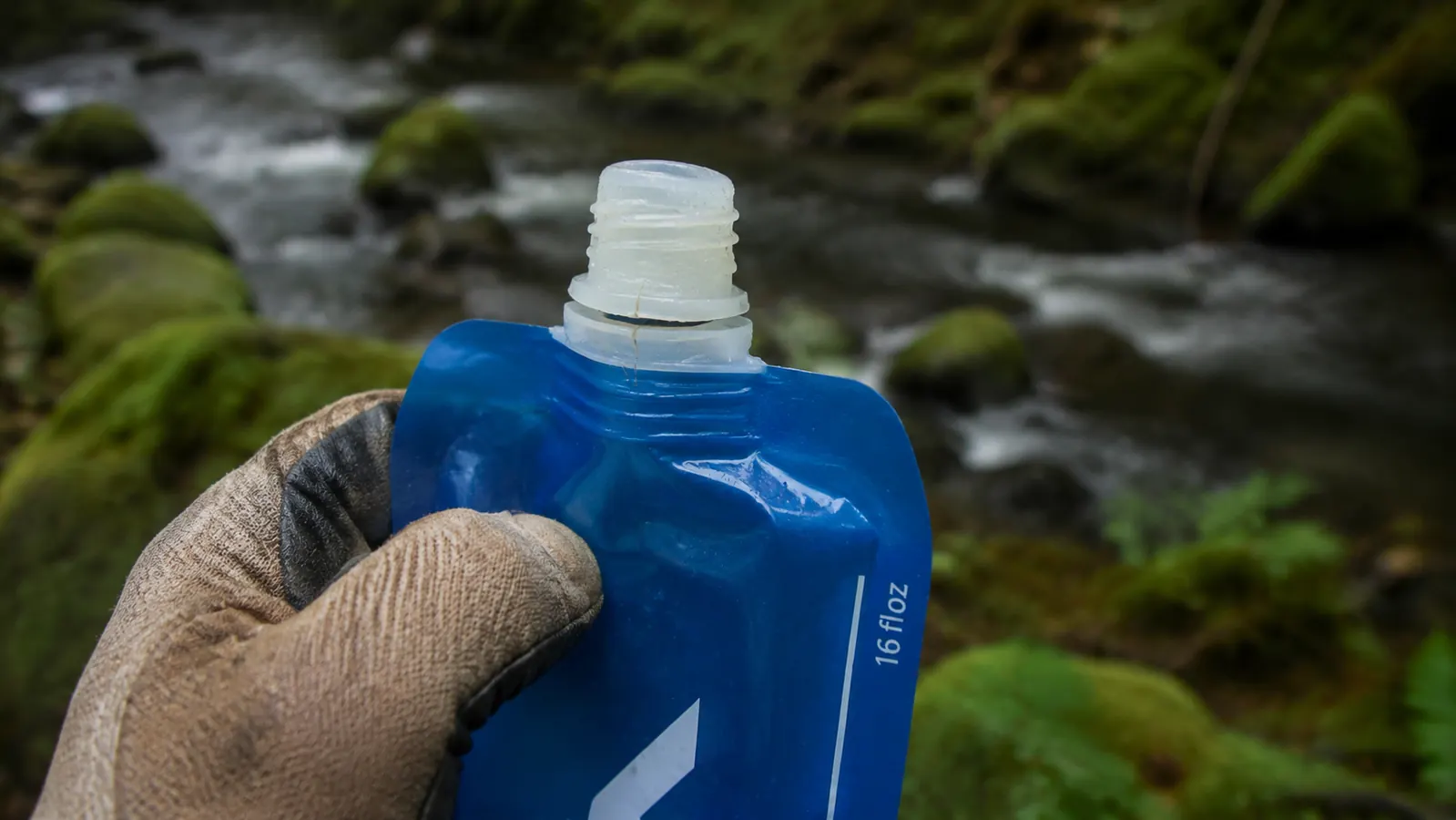
On a four-day loop in the Teanaway in August 2023, my squeeze pouch split at the threads on the second afternoon. Not a slow leak I could manage. A full-width crack that opened up when I gave the pouch a firm squeeze, sending about 12 ounces of filtered water across my chest and soaking my fleece mid-layer. I was two days from the trailhead, in 90-degree weather, with two other water sources nearby. It was annoying, not dangerous. But the fact that the pouch itself is the failure point that no one seems to talk about in Sawyer Squeeze reviews bothered me enough to pay attention to it from that point on. This article is what I have learned since, covering the failure modes that most of the positive reviews skip past.
To be clear about where I land: the Sawyer Squeeze SP131 is still the filter I carry. The filter element itself is genuinely excellent. I am not here to talk you out of buying it. But if you buy it based on the average Amazon review, you will be surprised by a few things that happen between months three and twelve. This review covers those things.
The Quick Verdict
The filter membrane is outstanding. The accessories bundled with it are mediocre. Buy the Sawyer Squeeze, replace the included pouches immediately with a CNOC Vecto or Platypus Softbottle, keep the filter above freezing, and replace the syringe every 18 months. Do all of that and this filter will outlast most of your other gear.
Amazon Check Today's Price →You came here because you want the honest picture before you buy. Fair enough. The filter itself is worth every cent.
The Sawyer Squeeze SP131 ships with two 32-oz pouches and a backflush syringe. Plan to replace the pouches. Check the current price and availability before your next trip.
Amazon Check Today's Price on Amazon →The Pouch Problem Nobody Wants to Lead With
The Sawyer Squeeze SP131 kit comes with two 32-oz squeeze pouches. They are made from a flexible plastic that feels durable when new. The problem is the threaded collar at the top, where the filter screws on. That collar is a molded plastic ring, thinner than it looks, and it takes the full mechanical stress every time you twist the filter on and off. Every squeeze you give the pouch pushes outward on that collar. Every time you backflush with the filter still attached, you torque the threads slightly. Over six to eight months of regular use, the plastic fatigues. What usually happens is a hairline crack develops at the base of the collar, invisible until the pouch is under pressure. Then you squeeze and the crack opens.
This is not an obscure defect. It is well documented across backpacking forums, Reddit threads in r/ultralight, and the one-star Amazon reviews that get buried under thousands of four-star ones. Sawyer has not changed the design meaningfully since the filter became popular. The two pouches in the kit are essentially consumables, and treating them as anything else sets you up for a surprise in the field.
My fix, which I wish I had implemented from day one: buy a CNOC Vecto 2-liter soft bag ($22, standard 28mm thread, much heavier-duty collar) or a Platypus Softbottle (similar thread standard, less prone to splitting). Screw your filter onto one of those instead. The included Sawyer pouches can serve as collection vessels at camp where you fill them partway and do not squeeze hard. Or just set them aside as backup. But the CNOC bag as your primary squeeze vessel changes this whole system for the better. I have had mine for 22 months and zero thread issues.
The Syringe Has a Lifespan Too
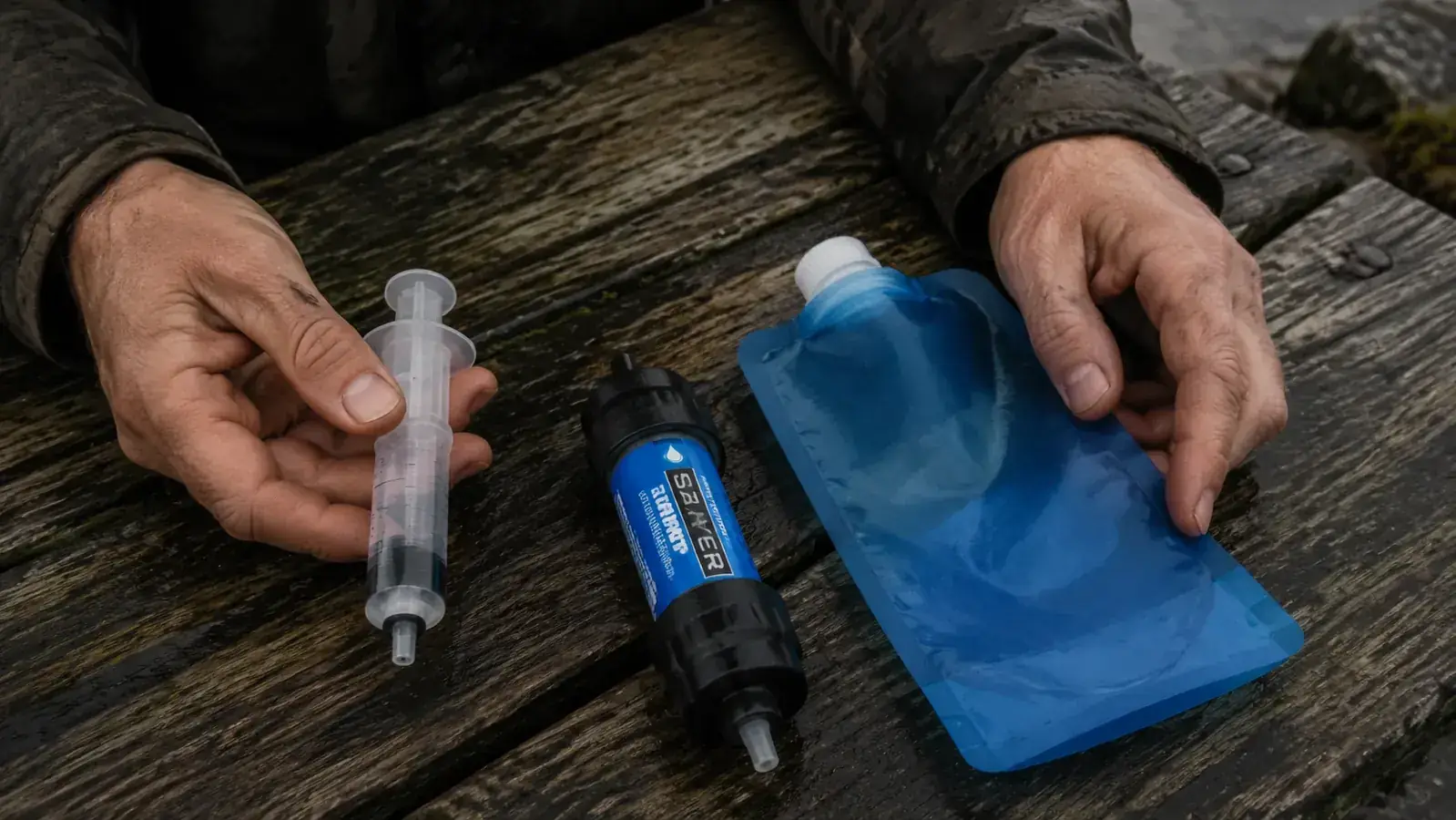
The Sawyer Squeeze ships with a backflush syringe: a small plastic plunger tool you fill with clean water and push backward through the filter output to dislodge clogged particles from the hollow fiber membrane. The syringe is the right design for the job. Backflushing is the main maintenance action that extends filter life and restores flow rate. Without it, flow drops significantly. With consistent backflushing, flow stays close to the factory rate.
What nobody tells you: the syringe itself degrades. The plunger seal inside the barrel dries out and loses its compression, usually around the 18-month mark if you use and wash the syringe regularly. When the seal goes, the syringe no longer generates enough pressure for a proper backflush. You can feel it: instead of a firm push that forces water through the filter, the plunger compresses with almost no resistance and the water barely trickles back through. At that point your backflushing is theater. The filter membrane gradually loads up with sediment and your flow rate stays slow no matter how many times you run the syringe through it.
Replacement syringes are cheap and sold separately on Amazon. I keep a spare in my repair kit. The fix is easy once you know the problem exists. The issue is that most backpackers assume the syringe is a permanent tool that needs no attention, because that is how it is presented in the Sawyer marketing and most review write-ups.
Once the syringe seal goes, your backflushing is theater. The membrane loads up with sediment and the flow rate stays slow no matter how many times you try. A spare syringe weighs 0.3 oz. Carry one.
Freeze Damage: Invisible Until You Are Sick
The Sawyer Squeeze uses hollow fiber membranes, which are thousands of tiny tubes made from a semi-permeable polymer material. Water passes through the pores in the tube walls; protozoa and bacteria are too large to fit and get blocked. This design is highly effective and lightweight. It also has one catastrophic vulnerability: if water inside the fibers freezes, the expanding ice can crack the fiber walls. Once cracked, the pores are no longer intact and the filter does not block pathogens at the rated level.
The problem is that you cannot see cracked hollow fibers. The filter looks exactly the same. The output tastes and smells exactly the same. Flow rate may actually improve after a freeze event because the cracked fibers pass water faster. There is no field test you can run to confirm the membrane is intact. If you have a compromised filter and you do not know it, you are drinking water that may contain Giardia or Cryptosporidium with a false sense of protection. That scenario is worse than carrying no filter and knowing you need to treat water by other means.
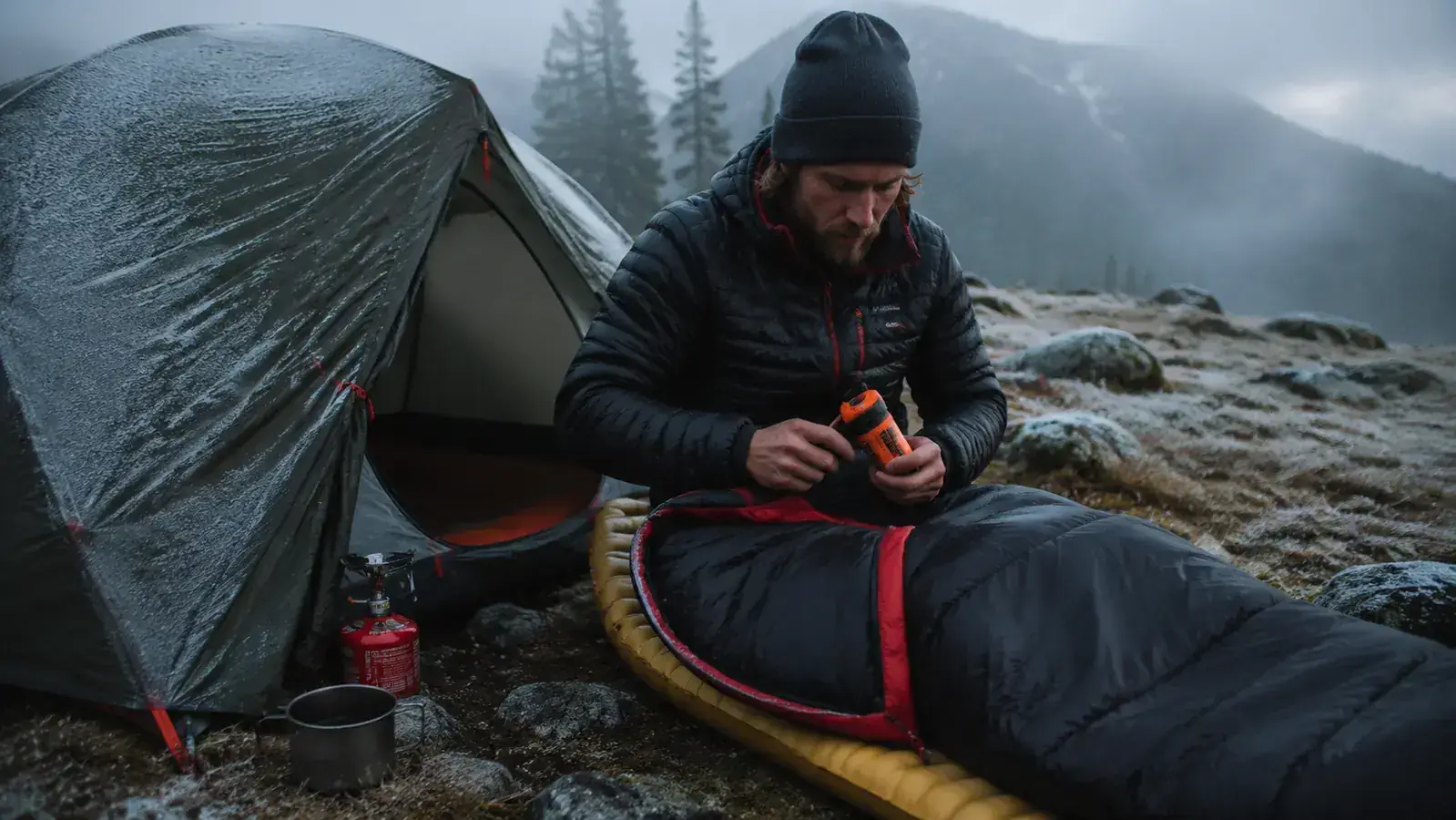
In the PNW, this is a real-world concern from late September through May at anything above 3,500 feet. I keep the filter in my sleeping bag any night temperatures are forecast below 30 degrees Fahrenheit. On day hikes in fall, it goes in an interior jacket pocket. If the filter has been left in a pack overnight in sub-freezing conditions without temperature protection, I treat it as compromised and run Aquatabs in parallel. Two Aquatabs (one tablet per liter, two minutes contact time) weigh less than two grams and give me a chemical backstop while I decide whether to trust the filter. Aquatabs and similar chlorine dioxide tablets do not address the viral gap on their own either, but combined with an intact squeeze filter you have reasonable coverage against the major biological threats.
Threading Compatibility: What Works, What Does Not
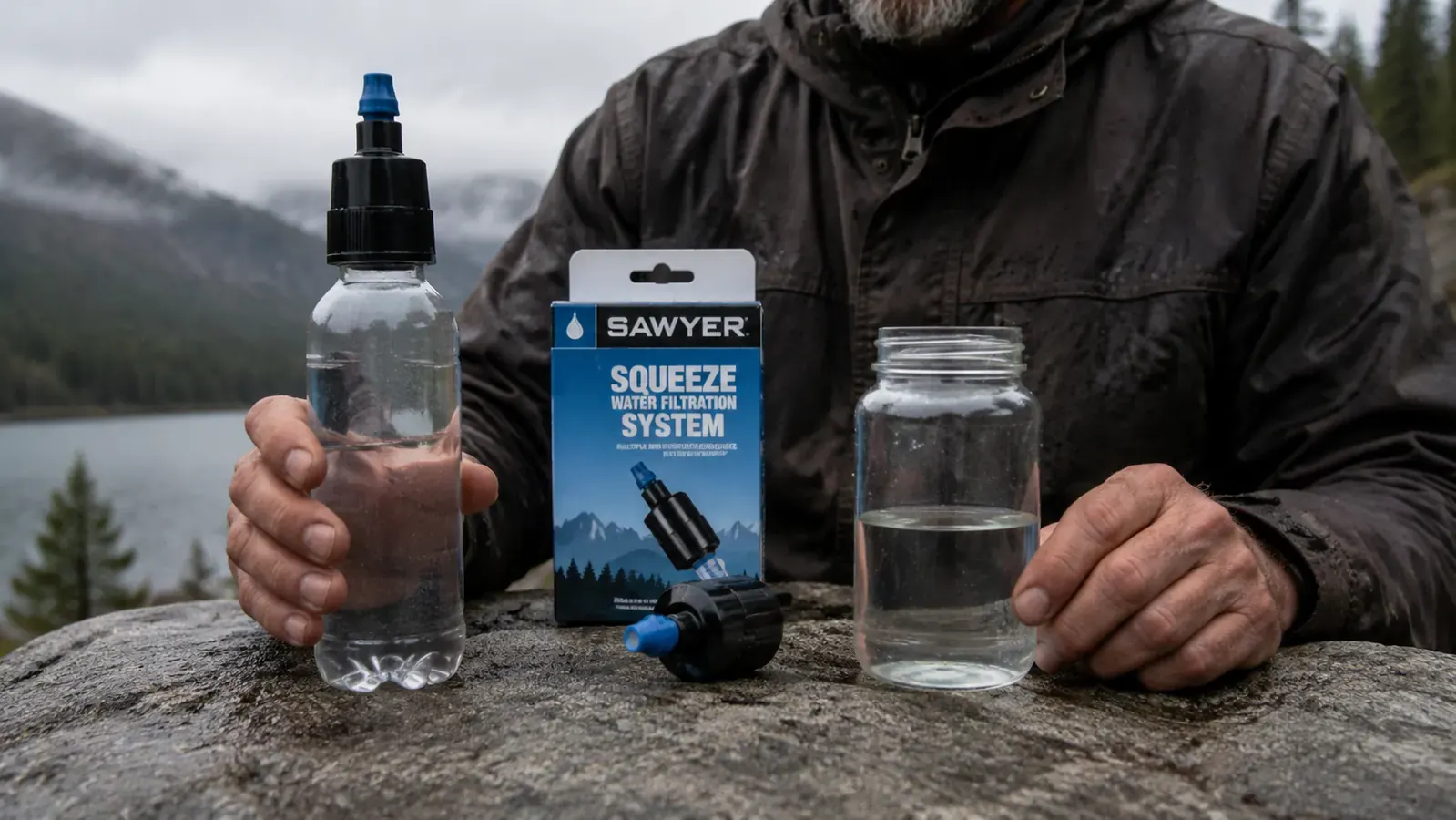
The Sawyer Squeeze uses a standard 28mm thread, which it shares with a lot of plastic water bottles. This is one of the design choices that makes it so versatile. You can screw the filter directly onto a standard Smartwater or Kirkland water bottle and drink straight through it like a straw, or squeeze the bottle to push water through the filter into another vessel. A lot of solo backpackers run this setup because disposable Smartwater bottles are cheap, lightweight, and replace the fragile Sawyer pouches cleanly.
What does not work: wide-mouth Nalgene bottles (63mm thread, completely different), most CamelBak reservoirs (proprietary bite valve fittings), and some older-generation Platypus bags with non-standard collar dimensions. I have seen people at trailheads try to muscle a Sawyer onto a wide-mouth Nalgene. It will not thread. If your only water storage is a wide-mouth Nalgene, you are using the filter as a squeeze-to-separate-vessel system, not an inline drink system, which is fine but limits your options. Standard Nalgene narrow-mouth bottles do use 28mm threads and work correctly with the Sawyer Squeeze.
There is also a threading wear issue specific to the Sawyer filter housing itself. If you cross-thread the filter onto a bottle or bag in the dark or when your hands are wet and cold, you can strip the female threads on the filter body. Sawyer's plastic threads are softer than what you find on quality stainless or aluminum bottles. Cross-threading once usually does not ruin the filter. A habit of cross-threading it, or overtightening after a backflush, will eventually strip the threads enough that you get a slow leak at the joint. The fix is to find the thread start carefully before applying any torque, which is easy in daylight and harder when you are dehydrated and tired at 6,000 feet.
How Bad Does Flow Get Without Backflushing
Most reviewers mention that backflushing is necessary and that flow rate drops over time without it. What they rarely quantify is how dramatic that drop actually is in silty water conditions, which is exactly the kind of water you encounter in early season snowmelt and after rain events in the Cascades.
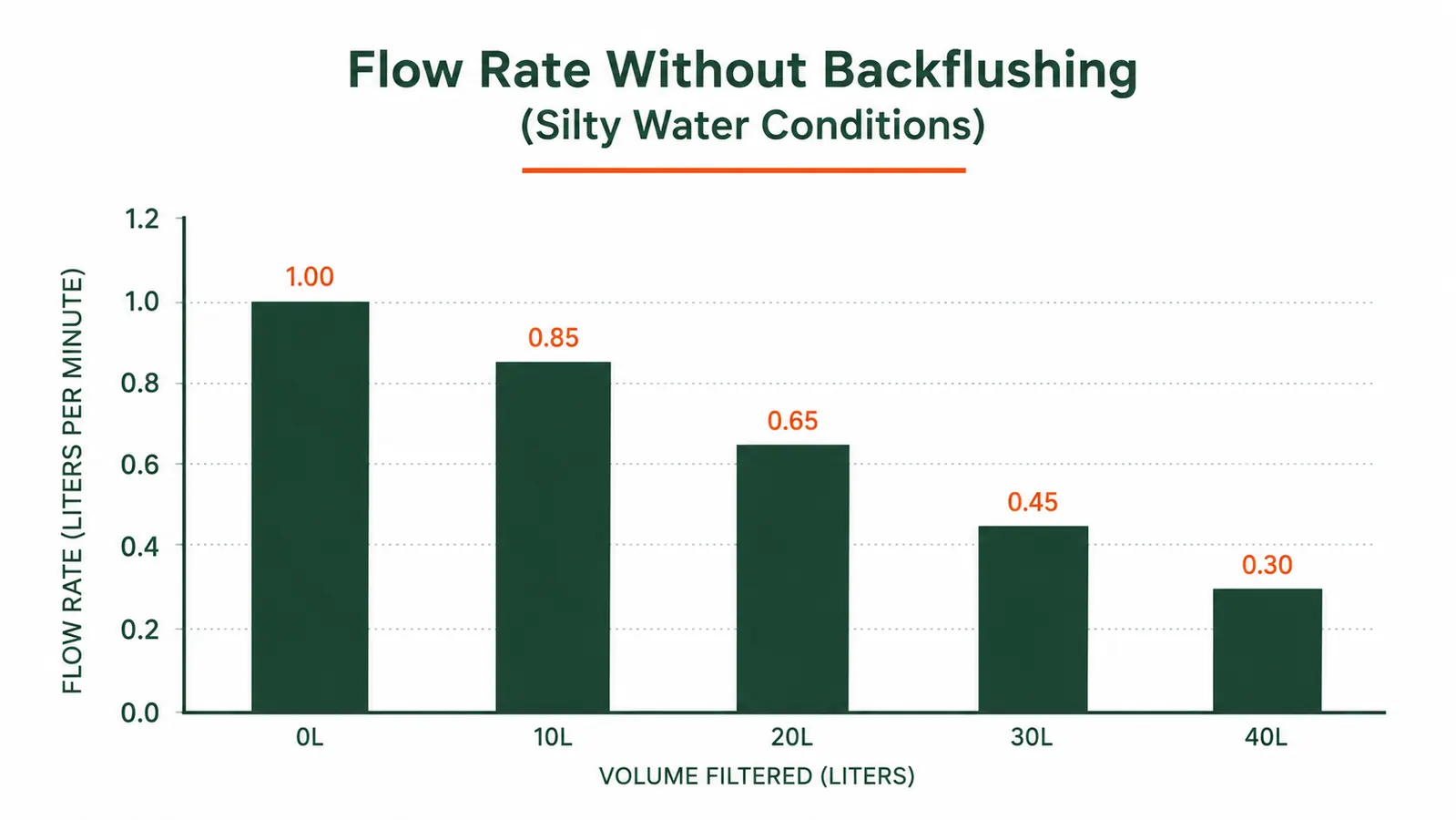
I ran a deliberate test on a trip in May 2024 in the Mount Baker Wilderness, filtering from a silty glacially-fed creek. Starting flow rate from a fresh backflush: 1.0 liter per minute. After 10 liters: 0.85 liters per minute, marginal difference. After 20 liters: 0.65 liters per minute, noticeably slower. After 30 liters: 0.45 liters per minute, annoying to use. After 40 liters: 0.3 liters per minute. At that point, filling a 1-liter bottle from the pouch required about three and a half minutes of squeezing and resting my hands. A proper backflush at camp restored flow to 0.88 liters per minute the next morning.
Clear, cold alpine water is much more forgiving. On the same trip, filtering from a clear snowmelt pool the following day, I ran 25 liters and the flow was still at 0.8 liters per minute with no backflush. The lesson is that source water matters a lot for in-use performance. If you are filtering silty, glacial, or post-rain creek water, plan to backflush every 10 to 15 liters, not every trip. If the water is clear and cold, every 25 to 30 liters is reasonable.
The Virus Gap from a Prepper Standpoint
The Sawyer Squeeze removes bacteria and protozoa at 0.1 absolute microns. It does not remove viruses, which range from 0.02 to 0.1 microns and pass through hollow fiber membranes. In most backcountry settings in the continental US, viral contamination of water sources is genuinely low risk, and I do not add chemical treatment on the majority of my trips. But the prepper framing is different from the weekend-backpacker framing.
In a prolonged grid-down or evacuation scenario, water sources that look wilderness-clean may not be. If upstream infrastructure fails, if sewage systems back up, if a large population starts using the same watershed, viral contamination risk goes up substantially. Hepatitis A, Norovirus, and similar pathogens in a water supply when medical care is unavailable is a serious situation. The Sawyer Squeeze alone is not your final answer for that scenario. A two-stage system, hollow fiber filtration followed by chemical disinfection with chlorine dioxide tablets (Aquatabs, Potable Aqua, or similar), addresses bacteria, protozoa, and viruses. The Sawyer Squeeze is still the right stage-one tool. Just do not treat it as a complete solution for worst-case water quality.
What I Liked
- 0.1-micron hollow fiber membrane is genuinely effective against all bacteria and protozoa at North American backcountry sources
- Filter element rated to 100,000 gallons; essentially unlimited lifespan for personal use if protected from freezing
- Compatible with Smartwater bottles and narrow-mouth Nalgenes for versatile drink-through or squeeze use
- At 3.0 oz for the filter alone, negligible pack weight
- Inline hydration reservoir use works well once you add a quality soft bag
- Backflushing restores flow rate fully when done with a functioning syringe
Where It Falls Short
- Included squeeze pouches have thin threaded collars that develop hairline cracks in 6-8 months of regular use; treat them as consumables
- Backflush syringe seal degrades around 18 months; a dead syringe means ineffective maintenance and creeping flow loss
- Freeze damage to hollow fibers is invisible from the outside; a compromised filter looks and flows identically to an intact one
- Flow rate can drop to 0.3 liters per minute without backflushing in silty water after 40 liters
- Does not remove viruses; incomplete solution for high-risk or grid-down scenarios without added chemical treatment
- Threading is 28mm standard but easily cross-threaded in cold or low-light conditions; overtightening wears the filter body threads
Who This Filter Is Right For
If you are a weekend backpacker or day hiker filtering from clear backcountry sources in Washington, Oregon, or similar wilderness terrain, the Sawyer Squeeze handles your actual risk profile extremely well. The filter element is as reliable as any hollow fiber system on the market at any price. The total package, filter plus a quality third-party bag plus a spare syringe, costs about $65 to $70 and covers years of use. It is the right starting point for most people building a backcountry water kit or a preparedness bag.
Who Should Think Twice or Add Something
If you camp frequently in October through May in the Cascades or Olympics and cannot reliably keep the filter above freezing overnight, carry Aquatabs as a backup and know your protocol if you suspect freeze damage. If you are a prepper building a 72-hour or extended emergency kit, budget for chlorine dioxide tablets alongside the Sawyer Squeeze and understand that the filter is your first stage, not your only stage. If you are doing international travel in regions with documented viral water contamination, the Sawyer alone is not enough and you need UV or chemical treatment as a second step. None of these are reasons to skip the Sawyer Squeeze. They are reasons to understand what you are buying.
Still the filter I carry on every trip. Buy it with your eyes open, replace the pouches, and it will not let you down.
The Sawyer Squeeze SP131 ships with two 32-oz pouches and a backflush syringe. Pair it with a CNOC Vecto bag and a spare syringe and this kit is complete. Check today's price before your next trip.
Amazon Check Today's Price on Amazon →