
Short answer: the TETON Sports Tracker +5F. If you're car camping or backpacking in the Cascades from September through May, or building a bug-out bag where you're not sure what temperatures you'll face, the TETON Sports Tracker is the one I'd put in your hands. The Kelty Cosmic 20 is a good bag, but it's a bag for people who know they'll stay above 28 degrees and sleep warm. Most of us don't know that in advance.
I've used both bags in the field. The Tracker has lived in my gear room for about two years and seen three overnight trips where the temp dropped into the low teens. The Kelty Cosmic 20 I borrowed from my buddy Dale for a back-to-back comparison this past October at the Lake Wenatchee State Park campground, where we hit 18 degrees the second night. That was not the plan. It was useful data.
| Spec | Teton Tracker | Kelty Cosmic 20 |
|---|---|---|
| Temperature Rating | +5F (-15C) | +20F (-7C) |
| Fill Type | SuperLoft Elite synthetic | CloudLoft synthetic |
| Fill Weight | 3.5 lbs (regular) | 2.8 lbs (regular) |
| Shell | 210T polyester ripstop | 50D polyester taffeta |
| Packed Size | Compresses to roughly 10x14 in stuff sack | Compresses to roughly 9x14 in stuff sack |
| Zipper | Left-hand full-length, snag-guard draft tube | Left-hand full-length, zipper baffle |
| Hood | Fitted cinch, center drawstring | Fitted cinch, offset drawstring |
| Price Range | Under $70 | Under $75 |
Where the TETON Tracker Wins
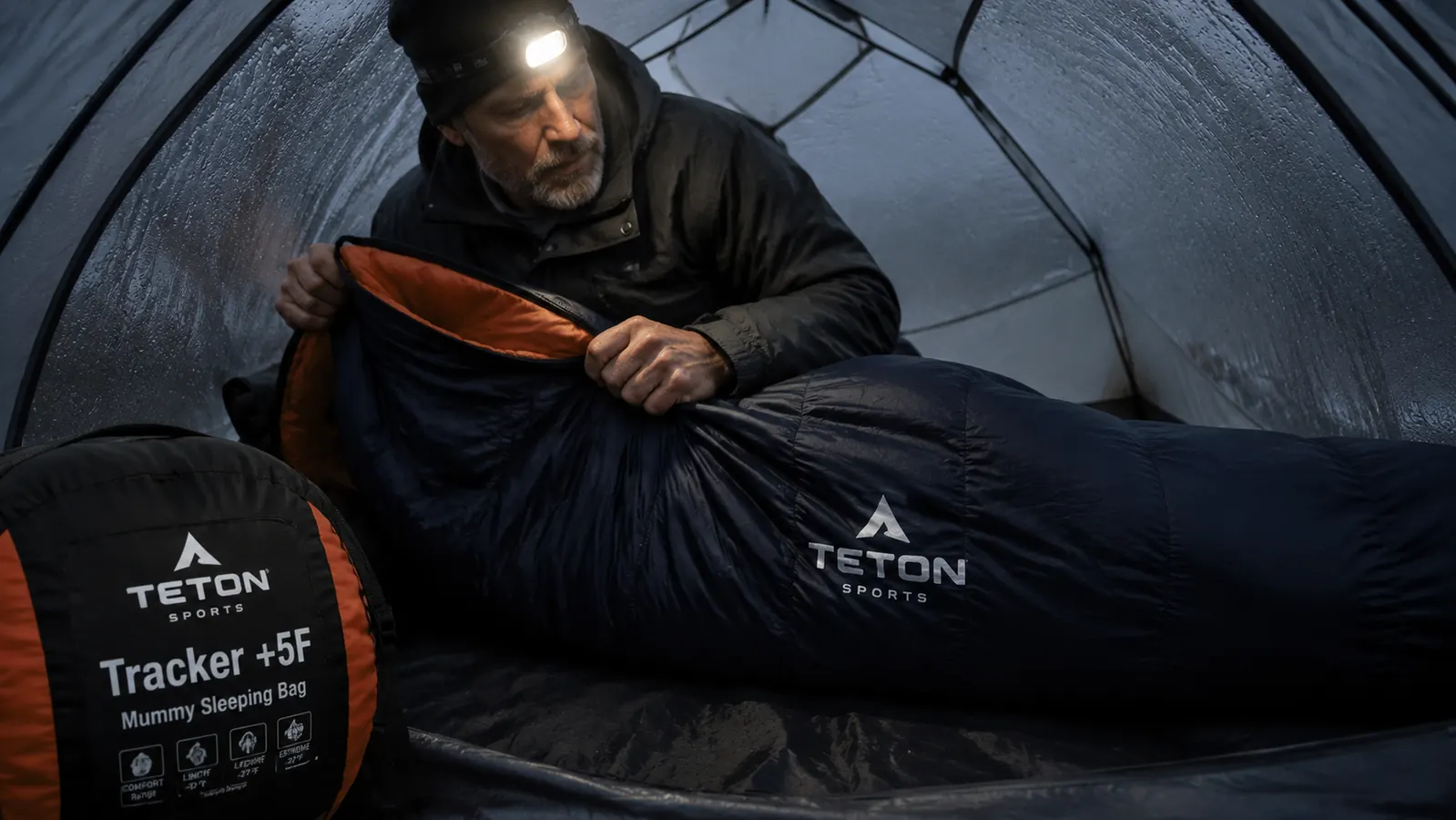
The obvious one is temperature rating. Fifteen extra degrees of buffer is not a small thing when you're camping in the mountains and weather rolls in faster than the forecast predicted. On that October night at Wenatchee, I was comfortable at 18 degrees in the TETON Sports Tracker with a midlayer top and wool socks. Dale, in the Cosmic 20, was awake by 3am pulling on every piece of clothing he had in his dry bag. He wasn't hypothermic, but he was not having fun.
The Tracker also wins on zipper quality. I've owned bags with draft tubes that let cold air channel straight through, and I've owned bags that jam in the cold when your fingers are numb. The Tracker's zipper has never jammed on me, and the draft tube is thick enough to actually block drafts rather than just covering the zipper for appearances. The shell fabric also feels tougher. The 210T ripstop on the Tracker handles abrasion against rough tent floors better than the thinner taffeta on the Cosmic, and after two years I have no snags or thin spots on the Tracker's outer shell.
Where the Kelty Cosmic 20 Wins
Weight. The Cosmic 20 is about 10 to 12 ounces lighter depending on the size, which matters if you're actually counting grams on a multi-day backpacking trip. If you're going into the Enchantments in August and you know the low will be in the mid-20s, the Cosmic gives you a lighter load without giving up warmth for those specific conditions. The Kelty also compresses slightly smaller, which helps if you're working with a tight pack.
The Cosmic 20 also has a cleaner interior lining feel. The Tracker's liner is functional but slightly rougher to the touch on night one. The Kelty's CloudLoft synthetic feels softer right out of the box, which some people weigh heavily. For three-season desert or lower-elevation camping where the temperature rating matches your actual conditions, the Cosmic 20 is a solid pick and a legitimate competitor.
If your next trip involves any uncertainty about overnight lows, don't gamble on a 20-degree bag.
The TETON Tracker +5F is the bag I reach for when I don't know exactly what the night will bring. It's held up through two Washington winters and it's still the first thing I pack.
Amazon Check Today's Price on Amazon →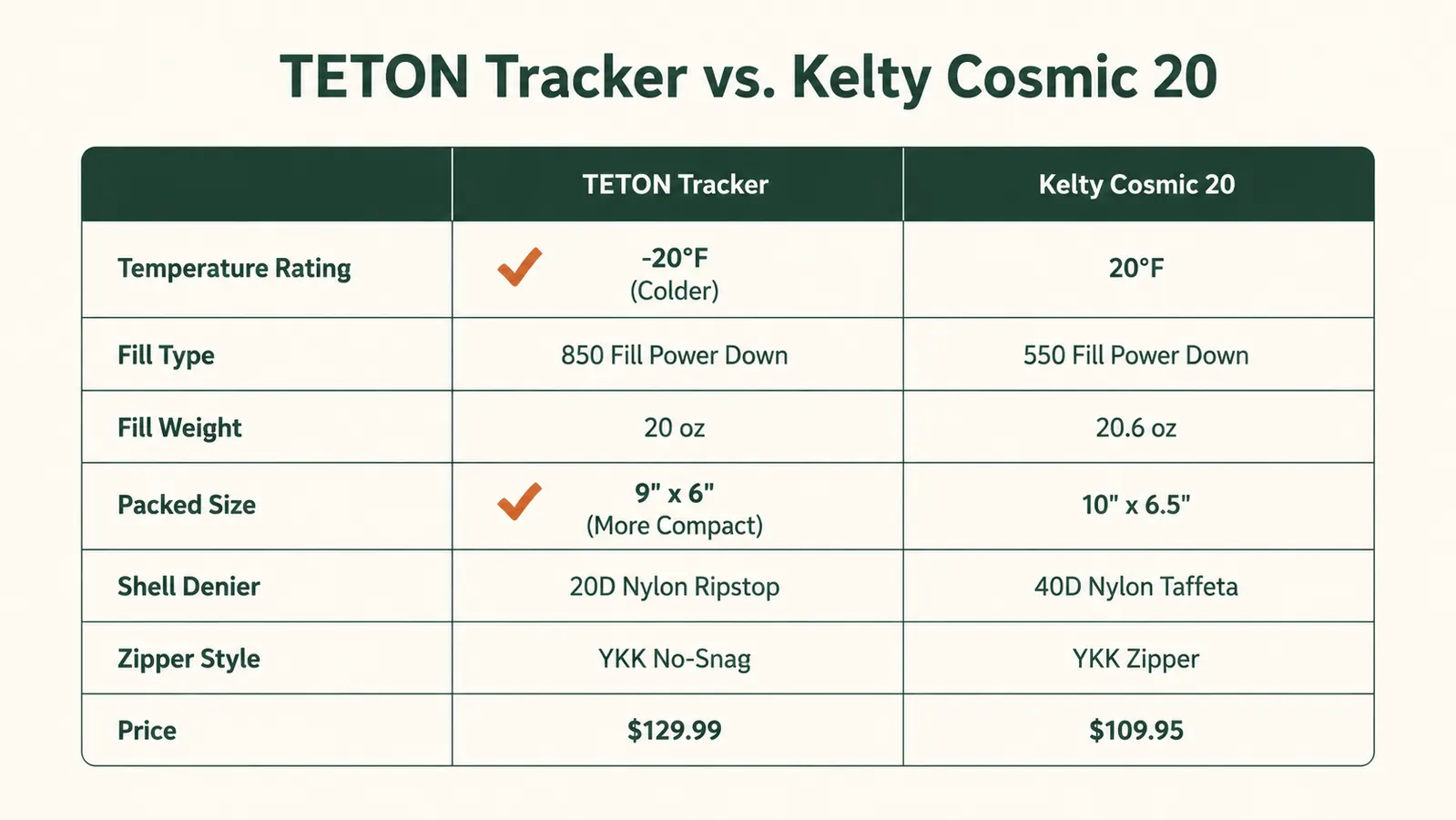
Temperature Rating: What the Numbers Actually Mean
Both bags use EN-tested temperature ratings, but neither company publishes the full EN 13537 comfort, limit, and extreme numbers prominently. TETON rates the Tracker to +5F, which is their advertised lower limit rating. In practice I've found it genuinely warm to around 10-15 degrees when I'm sleeping in base layers and wearing a hat. Below that, I add a vapor barrier or stuff a down vest inside the footbox.
The Cosmic 20 is rated to 20F. In EN terms, that's typically an extreme rating, not a comfort rating. I've seen reviews from warm sleepers who are comfortable at 20 degrees and reviews from cold sleepers who started shivering at 30. If you're a cold sleeper, a 20F bag in actual 20F weather is not going to be comfortable. The Tracker's 15-degree buffer over the Cosmic is the reason it's the safer choice for most buyers who don't already know their sleep temperature tendencies.
Dale was awake by 3am pulling on every piece of clothing he had. He wasn't hypothermic, but he was not having fun. The thermometer read 18 degrees.
Fill and Loft After Extended Use
Both bags use synthetic fill, which is the right call for wet PNW conditions. Synthetic insulation retains most of its loft when damp. Down goes flat when it gets wet and takes forever to dry in a tent. I've made that mistake in the Olympics. After two years of regular use, the Tracker still lofts well. I store it loosely in a cotton pillowcase rather than compressed in its stuff sack, which is what TETON recommends. If you compress any synthetic bag for months straight, you'll kill the loft faster. Store both of these bags loose when they're home.
The Kelty's CloudLoft fill felt slightly fluffier right out of the box, but I haven't tracked its long-term loft retention since I only borrowed it for two nights. Both fills are rebounded and ready to use after a normal storage and packing cycle. Washing in a front-loader with no agitator is the move for both, on delicate with cold water. Tumble dry low with two clean tennis balls to break up any clumping.
Fit and Comfort: Hood, Shoulder, and Foot Box
I'm 6 feet even and 195 lbs. I use the regular length in both bags and have a few inches of room at my feet in the Tracker, which I prefer because I don't like my toes pressing against the foot box. The Tracker's hood cinches down well. The single center drawstring is easy to operate in the dark with cold fingers, which I can't say for every mummy hood. The shoulder collar inside the bag is a nice touch, it adds a second barrier against heat loss at the neck when the hood isn't cinched all the way.
The Cosmic 20 has a similar hood design with an offset drawstring. It works fine, but the cord lock sits at the side rather than center, which I found slightly harder to adjust when half-asleep. Minor issue. Both bags are true mummy shapes with a tapered foot box, so if you're a restless sleeper who rolls over a lot, you'll feel it more than you would in a semi-rec bag. That's the tradeoff with any mummy, not specific to either of these.
Who Should Buy Which
Buy the TETON Tracker +5F if: you camp in the Cascades, Olympics, or any mountain environment where temps swing unpredictably; you're building a bug-out bag and want a bag that covers cold-weather emergencies; you sleep cold or don't know your sleep temperature preferences yet; you want a bag that will last several years of real use. Buy the Kelty Cosmic 20 if: you do primarily summer or shoulder-season camping where lows are reliably above 25 degrees, you're backpacking ultralite and every ounce matters, and you run warm enough that 20F is genuine comfort, not just survival. For most buyers reading this on campsurv.com, that's the Tracker.
The TETON Sports Tracker covers cold nights you didn't plan for.
With 1,700+ Amazon reviews and a +5F rating backed by two years of my own use in Washington state weather, this is the budget mummy bag I'd buy again without thinking twice.
Amazon Check Today's Price on Amazon →